How Does It Work — and Is It Right for You?
Updated 2025 | A Science-Grounded Guide to the Newest Regenerative Hair Loss Treatment
Reviewed for clinical accuracy by a licensed hair restoration and regenerative medicine specialist | For informational purposes only — not a substitute for a personalised medical consultation
If you have spent any time researching hair loss treatments recently, you have probably come across exosome therapy. It is being talked about as the most exciting development in regenerative hair medicine in years — and unlike a lot of things that get described that way, there is genuine science behind it. The early clinical results are encouraging, and the biological rationale for why it should work is more solid than many treatments that have preceded it.
That said, exosome therapy for hair loss is still an emerging treatment. The evidence base is building rather than complete. The long-term durability data is limited. And the quality and sourcing of the exosome products being used across different clinics varies in ways that matter. Walking into any discussion of this treatment with those facts in mind is the most useful thing this guide can do.
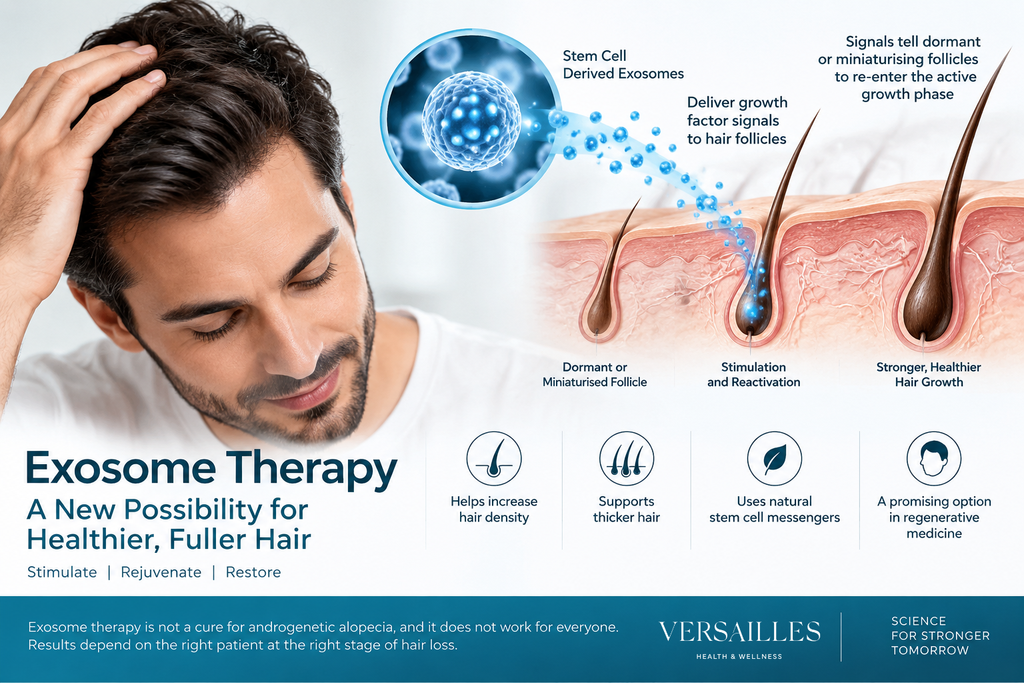
The honest starting point: exosome therapy uses tiny biological messengers derived from stem cells to deliver growth factor signals directly to hair follicles. Those signals tell dormant or miniaturising follicles to re-enter the active growth phase. In the right patient at the right stage of hair loss, this produces measurable improvement in hair density and thickness. It is not a cure for androgenetic alopecia, and it does not work for everyone — but it is a legitimate and promising option in the regenerative medicine toolkit.
What Are Exosomes — and Where Do They Come From?
Exosomes are nano-sized vesicles — tiny bubble-like structures — produced naturally by cells throughout the body as part of their normal communication system. They are roughly 30 to 150 nanometres in diameter, which makes them invisible under a standard microscope and roughly one-thousandth the size of a human hair. Despite their small size, they carry a remarkable payload: proteins, lipids, messenger RNA, microRNA, and growth factors that can be delivered from one cell to another, carrying instructions that change how the receiving cell behaves.
In the context of hair loss treatment, the exosomes used are derived from mesenchymal stem cells (MSCs) — a type of multipotent stem cell found in bone marrow, fat tissue, and umbilical cord tissue. These MSCs are cultivated in a laboratory environment, where they produce and release large quantities of exosomes. The exosomes are then harvested, purified, and concentrated into a serum that can be injected into the scalp.
The key distinction from older regenerative approaches — particularly PRP (platelet-rich plasma) — is that exosomes are not cells. They cannot divide, differentiate, or replicate. What they can do is deliver a highly concentrated and standardised package of cell-signalling molecules directly to the target tissue. In the context of hair follicles, that means triggering biological changes in the follicle’s immediate environment that support growth rather than dormancy or regression.
Exosome Therapy for Hair Loss — At a Glance
| Category | Details |
| What it is | Injections of exosomes — nano-sized cell messengers derived from stem cells — into the scalp |
| How it works | Delivers growth factor signals that instruct hair follicles to re-enter the active growth phase |
| Evidence level | Emerging — early clinical results are promising; large randomised controlled trials are still building |
| Session count | Typically 1–3 sessions; some protocols use monthly treatments for 3–6 months initially |
| Downtime | Minimal — mild scalp tenderness and redness for 24–48 hours; no recovery period |
| When you see results | 3–6 months for visible improvement; full benefit often at 6–12 months |
| How long it lasts | Results appear to extend beyond the treatment period; maintenance sessions may be needed at 12–18 months |
| Best for | Androgenetic alopecia (early to moderate); diffuse thinning; post-partum hair loss; complement to transplant |
| Not suitable for | Severe or advanced alopecia where follicles are no longer present; active scalp infection |
| Vs PRP | Exosomes deliver a more concentrated, standardised package of signals; do not require a blood draw |
How Exosome Therapy Actually Works on Hair Follicles
Hair grows in cycles — anagen (active growth), catagen (transition), and telogen (resting/shedding). In androgenetic alopecia — the most common cause of hair loss in both men and women — follicles are progressively miniaturised by the hormone DHT (dihydrotestosterone). Over time, they spend more time in the telogen phase and less in anagen, producing shorter, finer hairs with each cycle until they stop producing visible hair altogether.
Exosome therapy addresses this at the level of the scalp microenvironment — the tissue immediately surrounding the follicle, including the dermal papilla cells that regulate the hair cycle. When exosomes are injected into this environment, they interact with the follicular cells and trigger several biological responses:
-> Growth factor delivery — exosomes carry concentrated amounts of VEGF (vascular endothelial growth factor), PDGF (platelet-derived growth factor), EGF (epidermal growth factor), FGF (fibroblast growth factor), and other signalling molecules that directly promote follicular activity and vascularity.
-> Anti-inflammatory signalling — inflammation in the scalp microenvironment is a contributing factor to follicle miniaturisation. Exosomes carry anti-inflammatory signals that help reduce this local inflammatory burden.
-> Stimulation of dermal papilla cells — the dermal papilla is the structure at the base of the follicle that regulates the hair cycle. Exosome signalling activates these cells and can push follicles from the telogen resting phase back into the anagen growth phase.
-> Wnt/beta-catenin pathway activation — this signalling pathway is critical for hair follicle development and regeneration. Multiple growth factors delivered by exosomes are known to activate this pathway, which is associated with hair follicle cycling and stem cell activity.
-> Improved blood supply — VEGF and related signals promote angiogenesis — the formation of new blood vessels — improving oxygen and nutrient delivery to follicles that may have been under-nourished in areas of thinning.
The result of these combined signals, in patients who respond well, is that follicles that were producing thin, weak hairs begin producing thicker, stronger ones — and follicles that had entered extended rest periods begin cycling again. The change is gradual rather than dramatic, with most patients seeing meaningful improvement between three and six months after treatment.
What the Evidence Shows — Honest and Current
Exosome therapy for hair loss is genuinely exciting from a scientific standpoint — and it is important to be clear about what ‘exciting’ does and does not mean in the context of a medical treatment.
The evidence supporting exosome therapy includes multiple early-phase clinical studies and case series showing measurable improvement in hair density, hair shaft thickness, and patient-reported outcomes in people with androgenetic alopecia. One frequently cited 2020 study published in the Stem Cells Translational Medicine journal found significant improvement in hair density and patient satisfaction in a small cohort at six months. Several single-centre clinical case reports have documented similar findings.
What the evidence does not yet include is large, randomised, placebo-controlled trials with long-term follow-up. This is the gold standard for medical evidence, and exosome therapy has not yet reached it. The studies that exist are generally small, not always blinded, and vary in the exosome source, dose, and administration protocol used — which makes direct comparison difficult.
This is not a reason to dismiss exosome therapy. PRP — which now has a substantially larger evidence base — also began at this stage. The trajectory of the research is positive, and the biological mechanism is well-grounded enough that the early results are biologically coherent rather than coincidental. But patients choosing exosome therapy should understand that they are choosing a treatment at an earlier evidence stage than established options like minoxidil, finasteride, or PRP — and that they are making that choice in part on biological rationale and early clinical signals rather than decades of outcome data.
Exosome Therapy vs PRP — What’s the Difference?
The most common question from patients considering exosome therapy is how it compares to PRP, which has been available for longer and has more established evidence. Here is an honest side-by-side:
| Factor | Exosome Therapy | PRP Therapy |
| Source | Stem cell-derived (mesenchymal stem cells) | Patient’s own blood (autologous) |
| Preparation | Pre-manufactured; no blood draw required | Blood drawn, centrifuged, prepared on-site |
| Growth factor load | Very high, standardised concentration | Variable — depends on patient’s platelet count and health |
| Mechanism | Delivers 100s of growth factors + RNA signals | Primarily PDGF, TGF-beta, VEGF, EGF from platelets |
| Consistency | Same product quality every session | Results vary by patient biology and lab protocol |
| Sessions needed | Typically 1–3 sessions | Typically 3–4 sessions, often quarterly maintenance |
| Cost | Higher per session — typically $1,500–$3,500 | Lower per session — typically $600–$1,500 |
| Evidence level | Emerging — promising early data | More established — more published controlled trials |
| Availability | Specialist clinics; not universally available yet | Widely available at hair restoration and aesthetic clinics |
The practical choice between exosome therapy and PRP is not straightforward. PRP has more evidence behind it and is widely available. Exosome therapy offers a higher and more standardised growth factor load without the variability of a blood draw, but costs more and has less long-term data. Many hair restoration specialists in 2025 use both — PRP for maintenance and cost-effectiveness, exosomes for cases where a more potent regenerative signal is needed or where patients want the most advanced available option.
Who Is a Good Candidate for Exosome Hair Therapy?
Not everyone with hair loss is equally likely to benefit from exosome therapy. The treatment is most appropriate for:
-> People with early to moderate androgenetic alopecia — where follicles are miniaturised and weakened but still present. Exosome therapy cannot restore hair in areas where follicles are completely gone.
-> People experiencing diffuse thinning across the scalp without complete follicle loss — a pattern common in women with female pattern hair loss.
-> Post-partum hair loss (telogen effluvium) — where follicles have entered mass rest following delivery and need stimulation to re-enter the growth phase.
-> People who have had a hair transplant and want to accelerate graft integration and improve growth of transplanted follicles — exosomes applied during or after transplant appear to improve graft survival and speed visible results.
-> People who want to combine a regenerative treatment with ongoing medical therapy (minoxidil, finasteride) for a comprehensive approach — exosomes do not replace medical therapy; they complement it.
Exosome therapy is less appropriate for people with very advanced hair loss where large areas of scalp have no remaining follicular units, for people with active scalp infections or inflammatory conditions, or as a standalone treatment when a patient has not yet tried or considered medical therapy first.
What a Session Looks Like and What to Expect
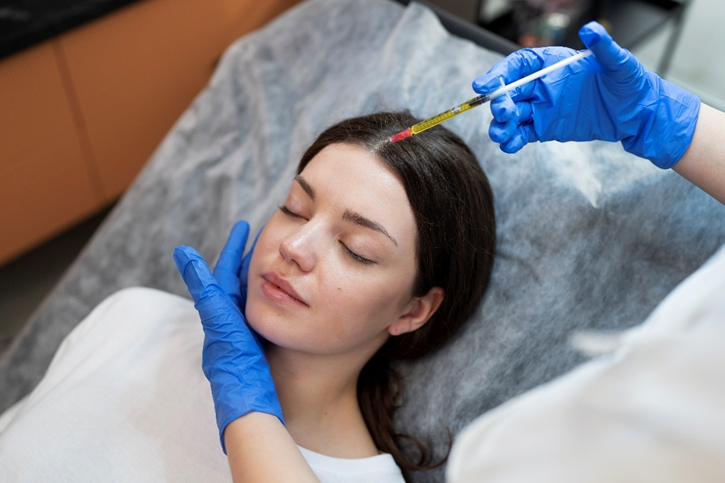
An exosome therapy session is straightforward compared to surgical hair restoration. The scalp is cleansed and a topical anaesthetic is applied if required. The exosome solution is then injected into the scalp using a fine needle or a microneedling device, distributing the product across the areas of thinning. Sessions typically take thirty to sixty minutes.
Post-treatment, mild redness and scalp tenderness are common for 24 to 48 hours. Most patients return to normal activities the same day. There is no meaningful downtime, no compression garment, and no restriction on washing the hair beyond a 24-hour waiting period.
The shedding phase that is common with some hair treatments — where existing hair temporarily sheds before new growth begins — can occur in some patients in the first four to six weeks after exosome treatment. This is a normal part of the follicular stimulation process and should not be confused with the treatment not working.
| The Most Important Decision: Choosing Where to Have This Treatment: Exosome product quality varies significantly between suppliers, and this matters more for exosome therapy than for almost any other injectable treatment. Unlike PRP, which is prepared from your own blood in a standardised process, exosome products come from external manufacturers whose quality controls, cell sourcing, and concentration standards differ. Ask specifically about the exosome source (MSCs from bone marrow, Wharton’s jelly, or adipose tissue), the concentration used (typically expressed as particles per mL — higher is generally better), whether the product is FDA-registered or CE-marked, and the clinic’s experience with the specific product they use. A clinic that cannot answer these questions clearly is not the right choice for this treatment. |
Frequently Asked Questions — Exosome Therapy for Hair Loss
How does exosome therapy work for hair loss?
Exosome therapy for hair loss delivers tiny biological messengers — exosomes derived from mesenchymal stem cells — directly into the scalp via injection. These exosomes carry a concentrated package of growth factors (VEGF, PDGF, EGF, FGF), anti-inflammatory signals, and RNA molecules that interact with hair follicle cells and the surrounding scalp microenvironment. The signals promote blood vessel formation, activate the dermal papilla cells that regulate the hair cycle, stimulate the Wnt/beta-catenin pathway associated with follicle regeneration, and help transition miniaturised or resting follicles back into the active growth phase.
Is exosome therapy better than PRP for hair loss?
Exosome therapy delivers a higher and more standardised concentration of growth factors than PRP, without the variability of a blood draw. Early evidence is encouraging, and the biological mechanism is well-grounded. However, PRP has a larger body of published clinical evidence, is more widely available, and costs significantly less per session. Many hair restoration specialists use both — PRP for maintenance and regular support, exosomes for cases where a more potent regenerative stimulus is needed. Neither is universally better; the right choice depends on the severity of hair loss, the patient’s budget, and their response to previous treatments.
How long does exosome hair treatment last?
Exosome therapy is not a permanent cure for hair loss — particularly androgenetic alopecia, which has a genetic and hormonal driver that continues after treatment. Results typically develop over three to six months and may persist for twelve to eighteen months before the hair loss driver reasserts itself. Most patients who respond well to exosome therapy are advised to consider maintenance sessions at twelve to eighteen month intervals, alongside ongoing medical therapy (minoxidil, finasteride) to slow progression between treatments.
Does exosome therapy for hair loss have side effects?
The side effects of exosome scalp injections are generally mild and short-lived. Common reactions include scalp tenderness, mild redness, and occasional swelling at injection sites, all typically resolving within 24 to 48 hours. Temporary shedding in the first four to six weeks after treatment can occur as follicles are stimulated — this is a known response and generally precedes improved growth. Serious adverse events have not been widely reported in the clinical literature, but long-term safety data is limited given the relatively recent availability of this treatment.
How many exosome sessions are needed for hair loss?
Most protocols for exosome hair therapy involve one to three sessions spaced four to six weeks apart for the initial treatment course. Some providers deliver a single high-concentration session. The number of sessions recommended typically depends on the degree of hair loss, the concentration of the exosome product used, and whether the treatment is being combined with other therapies such as microneedling or PRP. Maintenance sessions every twelve to eighteen months are commonly recommended for patients who achieve good initial results.
Can exosome therapy regrow hair on bald areas?
Exosome therapy requires living hair follicles to work — it stimulates and supports existing follicles but cannot regenerate follicles that are completely gone. In areas of the scalp that are completely bald with no remaining follicular units, exosome therapy will not produce new hair growth. It is most effective in areas where follicles are miniaturised, weakened, or in extended resting phases but still present. For areas of complete follicular loss, hair transplantation (which moves DHT-resistant follicles from the donor zone into bald areas) is the treatment that can address the concern directly.
Is Exosome Therapy Right for Your Hair Loss?
Exosome therapy represents a genuinely new approach to hair loss treatment — one grounded in well-established cell biology and producing early results that the research community is taking seriously. For patients with early to moderate androgenetic alopecia, diffuse thinning, or post-partum hair loss, it is a legitimate option that deserves a place in the conversation alongside PRP, medical therapy, and hair transplantation.
The honest caveat is that it is an emerging treatment. The evidence is encouraging and biologically coherent, but it is not yet at the level of established options. Patients choosing exosome therapy are making a reasonable bet on a treatment that is likely to develop a stronger evidence base over the next five years — and getting ahead of that curve carries some uncertainty alongside the potential benefit.
The consultation is where this decision should be made. A provider who assesses your specific pattern and degree of hair loss, explains the realistic range of outcomes for your situation, and discusses how exosome therapy fits into a broader management plan — rather than presenting it as a standalone cure — is the right partner for this conversation.
This article is for informational and educational purposes only. It does not constitute medical advice or a recommendation for any specific treatment or product. Hair loss treatment responses vary significantly by individual. Always consult a qualified and licensed medical practitioner before beginning any new treatment for hair loss.
Keywords: exosome therapy for hair loss · exosomes hair growth · exosome hair treatment · how does exosome therapy work for hair · exosome vs PRP hair loss · exosome scalp injections · mesenchymal stem cell hair treatment · regenerative hair therapy